History · 1986 to 2002
How racing looked, 1986 to 2002
In plain words. Old adverts, magazine pages and posters show how the sport looked between 1986 and 2002. The craft started out mostly white with simple stripes. From about 1992 they carried loud pinks, purples and teals. Race craft wore team colours and sponsor stickers, and the late 1990s pages show plainer blocks of colour.
The colours, lettering and dress of personal watercraft racing in its busiest years, read from period advertisements, magazine tests, event posters and race photographs that can still be opened, each page opened twice, on 2026-10-09 and 2026-10-10. None of those pages is reproduced here: each is linked where it is held, and its colours are described in words. The three photographs on this page are openly licensed pictures of the period that illustrate it; they are not among the pages read, and nothing in the sections rests on them.
Words on this page (3)
- Runabout
- A personal watercraft with a seat, ridden sitting down, and the division that races such craft. The IHRA book describes the runabout class as sit-down watercraft of a larger size and engine capacity than stand-up models, and UIM defines runabouts as craft for one or more people with a seat; IJSBA also keeps a separate Sport division beside its Ski and Runabout divisions.
- Stand-up
- A personal watercraft built for one rider who stands on it and steers with a pivoting handle pole. Rulebooks race these in the Ski division; the IHRA book uses stand-up as its plain word for the craft, in its Ski class rules and its drag classes.
- World Finals
- The IJSBA’s annual championship, run at Lake Havasu City.
- Dot: the document's date, as its record gives it
- A year with no month sits mid-year
- Hollow dot: a year given by the person who uploaded it, not printed on the document
- Bar: the model years a book covers, from its title; its record gives no date of printing
- Shaded: a year with no dot
Nothing on the strip falls in 1989, 1991, 1995, 1997 or 2001: no page this chapter read is dated then, which says nothing about the racing in those years. 1986 holds only the model years a book's title names. 1999 rests on an uploader's year alone.
- Three pages from 1987 to 1990
- model years 1986 to 1988, from its title, Kawasaki Model Recognition 1986-88; April 1987, Ski April 1987 Kawasaki advert; September 1988, Popular Mechanics Sept 1988 test; April 1990, Ski April 1990 WaveRunner LX advert
- Pages from 1992 to 1994
- April 1992, Ski April 1992 Polaris advert; January 1993, Cycle World Jan 1993 WaveBlaster advert; 1993, 1993 World Finals poster; July 1993, Popular Mechanics July 1993 test; March 1994, Ski 1994 Super Sport Xi advert
- Race craft
- January 1996, Boating Jan 1996 racing section; 1998, 1998 Kawasaki poster
- Pages from 1998 to 2002
- 1998, Boating 1998 test annual Tigershark; 1999 (the uploader's year), 1999 Sea-Doo XP Limited poster; 2000, 2000 World Championships poster; July 2002, Boating July 2002 Kawasaki feature
Undated or dated later, so not on the strip
- WCJ Splash gallery 2014, cited under Race craft, published 12 February 2014, after 2002, and gives no year for what it pictures.
- Jetpilot vintage capsule post, cited under Race craft, published 5 October 2023, after 2002, and gives no year for what it pictures.
- WCJ Hydro-Turf visit 2014, cited under Race craft, published 29 July 2014, after 2002.
Where the chapter's pages fall in time: each mark is one cited document, set at the date its record gives, in the row of the section that cites it. A cluster means more pages were read, not more racing.
How we know: the documents this chapter cites, each at the date its record gives, hollow where that year is only the uploader's, and the dealer book by the model years its title names.
Three pages from 1987 to 1990, white hulls and primary stripes
Kawasaki's range advertisement in Ski magazine for April 1987 shows a couple riding two-up on a white X-2 with a navy band and a red block under the wordmark, in red, white and blue striped vests and wraparound sunglasses, on deep blue water broken by heavy spray. Beneath it four craft stand on a purple-grey studio sweep: the JS300 white with red, blue and black stripes, the JS300SX white with red and navy, the JS440 white with red-orange stripes and the JS550 red with white. Kawasaki's own dealer book for 1986 to 1988 names the colours: Jet White for the JS300, the JS440, the JS650 and the JF650, and Optic Red for the JS550. Popular Mechanics' test of September 1988 shows the 1988 Sea-Doo white with a yellow logo, a mustard dashed stripe and a butter-yellow seat, and the WaveRunner white with a red stripe, under a red brush-script word and heavy black extended capitals. Yamaha's WaveRunner LX advertisement of April 1990 is white again, with a red and black pinstripe band and a black cowl and console, its couple in red and black vests, its copy set in a centred serif on a torn-paper panel. Both advertisements head their pages in a light classic serif, while the magazine's own test already used heavy extended capitals.
Sources: Ski April 1987 Kawasaki advert; Kawasaki Model Recognition 1986-88; Popular Mechanics Sept 1988 test; Ski April 1990 WaveRunner LX advert
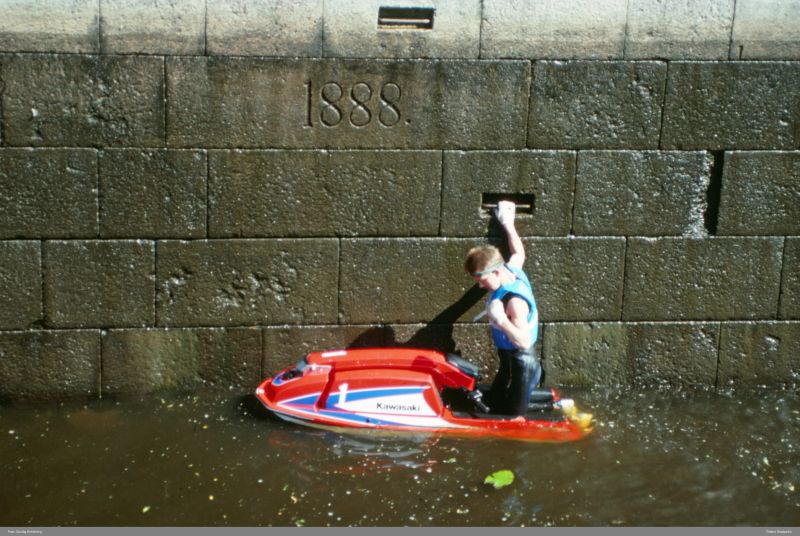
A red Kawasaki stand-up with white and blue stripes and a number 1 passing through a town lock in Örebro on the town's boat day, its rider standing in it and pulling it along the wall. It shows one craft on a lock passage on a day out, not a race, and its record names no model. Taken 11 June 1989 at the Nikolai lock, Örebro, Sweden, it is not one of the pages this chapter reads, so it illustrates and does not add evidence; it is shown resized and in another file format, otherwise unchanged.
Photo by Gunlög Enhörning / Örebro Stadsarkiv, CC BY 4.0.
How we know: the Örebro Stadsarkiv record for this photograph, which gives the day, the Nikolai lock and the town's boat day.
Pages from 1992 to 1994, pink, violet and teal on white
Polaris's SL 650 spread in Ski for April 1992 is a tabloid parody with a serif headline in white on a black bar; its hull is white with navy and magenta diagonal slashes, under a cobalt sky, and the people around it wear magenta and navy helmets and magenta gloves. Yamaha's advertisement introducing the WaveBlaster, in Cycle World for January 1993, shows a violet upper hull over white, a butter-yellow seat and black panels covered in an orange-red scribble, the name in brush script under ultra-heavy black extended capitals. Popular Mechanics' test of July 1993 runs its headline in upright, ultra-heavy extended capitals across both pages and photographs a Yamaha white with orange and blue lettering and orange and yellow speed slashes, a Polaris white with hot pink and royal blue, a Tigershark white with a purple seat and teal and magenta pinstripes, and a Kawasaki white with purple, teal and yellow; its riders wear blue and yellow vests, hot-pink and yellow gloves and purple shorts. The 1993 Skat-Trak World Finals poster puts teal block letters with black drop shadows over a hot pink and purple paint-swoosh wave, with yellow brush script and a pink border, and of the craft it pictures carrying number one plates, one is lime, orange and white with a purple rail and the other a red and white Kawasaki with PJS's chequer. Kawasaki's Super Sport Xi advertisement of March 1994 sets "KAWABUNGA!" in heavy black italic capitals across a blue-toned photograph, beside a headline in heavy black capitals. On these pages the colour sits mostly on white gelcoat as slashes, scribbles and pinstripes, the WaveBlaster's violet upper hull being the largest single area of it.
Sources: Ski April 1992 Polaris advert; Cycle World Jan 1993 WaveBlaster advert; Popular Mechanics July 1993 test; 1993 World Finals poster; Ski 1994 Super Sport Xi advert
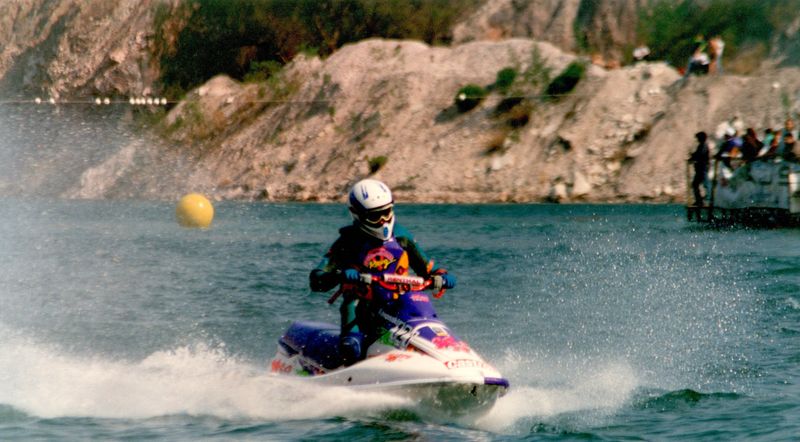
A Kawasaki at speed on Laguna Azul in Argentina, white with a violet deck and pink decals, its rider in a full-face helmet, past a yellow buoy with people watching. It shows one craft, and its page names no event, so whether this was a race is not stated. Taken 15 October 1994 at Laguna Azul, Córdoba, Argentina, it is not one of the pages this chapter reads, so it illustrates and does not add evidence; it is shown resized and in another file format, otherwise unchanged.
Photo by Vanina Ester Petigrossi de Bigi, CC BY-SA 3.0.
How we know: the date and place given on the photograph's Wikimedia Commons page; the file carries no camera date.
Race craft, shop decals and motocross helmets
Photographs of racing show the same colours put to work. A start line from a fan page's tribute to Splash magazine, republished by The Watercraft Journal in 2014 and carrying no year, has riders standing in the water at the tails of their stand-ups; the hulls are red, lemon yellow, magenta, blue and white, some carry PJS's chequered block with "Performance Jet Ski Inc." beneath it, the numbers are big black block numerals on white plates and one on yellow, and the riders wear full-face helmets. The jumping photograph at the head of Jetpilot's 2023 post on its vintage range shows white decks over hulls banded in magenta, lime and royal blue, WESTCOAST lettered across a number plate, SKAT TRAK and TEAM BUTCH'S on hulls, and a handle pole wrapped in magenta and lime. The IJSBA section in Boating for January 1996 shows the factory and shop colours of the mid-decade tour: a Kawasaki runabout with a violet deck, a white hull and a green stripe, a yellow and white Sea-Doo carrying Westcoast and Skat-Trak decals, a Yamaha stand-up with a yellow-to-red band, peaked motocross helmets throughout and Kawasaki's team truck. A Kawasaki poster of 1998, naming that year's national champions, still pictures white hulls with Kawasaki green and purple under Arai, UMI and Skat-Trak decals. A Watercraft Journal visit to the deck-mat maker in 2014 reports that in the mid-to-late 1980s, under the name Jet-Strip, it sold padding in "a full array of fluorescent hues", where the early stand-ups had come with black foam.
Sources: WCJ Splash gallery 2014; Jetpilot vintage capsule post; Boating Jan 1996 racing section; 1998 Kawasaki poster; WCJ Hydro-Turf visit 2014
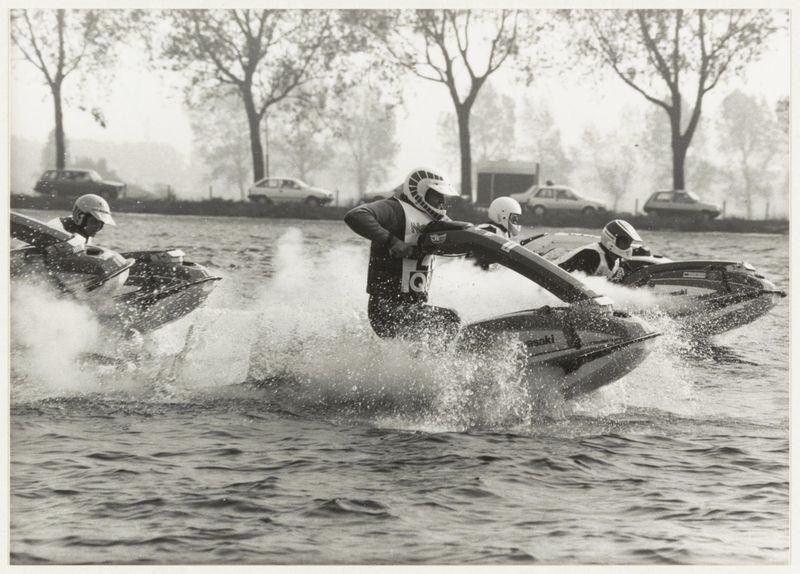
Stand-up craft racing at the Dutch championship on the Molenplas: riders in full-face helmets and bib vests with race lettering, throwing spray through a turn. It is black and white, so it shows the racing and the dress, not the colours this chapter describes. Taken 4 October 1987 at the Molenplas, Haarlem, the Netherlands, it is not one of the pages this chapter reads, so it illustrates and does not add evidence.
Photo by Poppe de Boer, Fotoburo de Boer collection, Noord-Hollands Archief, CC0 1.0.

How we know: the date and place in the Noord-Hollands Archief's record for this photograph, which names the Dutch jet ski championship on the Molenplas.
Pages from 1998 to 2002, plainer colour and quieter copy
By 1998 a magazine could praise a craft for doing without the loud graphics. Boating's 1998 test annual shows the Tigershark Daytona 1000 in red, its deck and hull divided by a white band, with yellow script, and praises a design that, in the reviewer's words, "doesn't resort to the boy-racer graphics" of other performance runabouts. Sea-Doo's XP Limited poster, dated 1999 by the collector who uploaded it, shows a black hull, yellow deck sides and a charcoal cowl and seat under black brushstroke graphics. The poster for the 2000 Skat-Trak World Championships at Lake Havasu sets its race photographs in a desert theme: a tan-to-orange sky, saguaro silhouettes, chunky red western capitals, frames of rope and wood, and a sponsor strip naming Kawasaki, Polaris, Sea-Doo and Yamaha beside Skat-Trak, Budweiser and the IJSBA. Kawasaki's advertising feature in Boating for July 2002 shows a white and metallic blue Ultra 130 under blue condensed capitals that call the good times "CLEAN", "SMART" and "QUIET", and its copy is about direct injection, emissions and noise. Across these pages the busy slashes of the early 1990s are gone: colour comes in fewer, larger blocks, in black and charcoal, or in metallic paint.
Sources: Boating 1998 test annual Tigershark; 1999 Sea-Doo XP Limited poster; 2000 World Championships poster; Boating July 2002 Kawasaki feature
-
1987 to 1990. A white hull with stripes along its side, as most craft on these pages wear them; the JS550 is the exception, a red hull.
-
1992 to 1994. Pinstripes and diagonal slashes on white, gathered from several pages onto one outline. The filled upper hull is one craft's, the WaveBlaster's, and the biggest patch of colour these pages show; its cowl is left plain and its scribbled black panels are not drawn, because the words do not say where they sit.
-
Race craft, years mixed. A broad band across the hull and a number plate, left blank. Banded hulls appear in two of the race photographs the chapter cites, and the start line shows big black numerals on white plates, one on yellow; where the plate sits here is the sketch's choice. The years are mixed because two of those photographs carry no date.
-
1998 to 2002. One large block on the lower hull under a lighter deck side, as the chapter describes the Sea-Doo XP Limited poster. Its charcoal cowl and seat and its black brushstroke graphics are not drawn. It shows the pages read, not a rule for those years: the Tigershark tested in 1998 is red with a white band.
- Filled: the main coloured area the words under the sketch name
- Tint: a second, smaller area
- Lines: stripes and pinstripes
- Hatch: slashes
- Outline only: white, or not drawn
Sketches drawn from this chapter's words, on the site's generic hull outlines, not traced from any advert, poster or photograph, and showing where colour sits, not which colour.
How we know: the four sections of this chapter, read for where each puts colour on a hull; two plain side views, a stand-up and a runabout, serve every sketch.
Not to scale.
- The sport had a golden age, or a golden era, from the late 1980s to the mid 1990s.
- No sanctioning body or maker read here uses the phrase; it comes from fan pages and podcasts. The years this chapter covers are given as dates, and which of them were best is not a thing a document can settle.
- The craft of the late 1980s were already fluorescent.
- The three dated pages from 1987 to 1990 read here show white hulls with red, navy, blue and yellow stripes. The fluorescent colours a 2014 trade piece describes for the late 1980s are deck mats, not hulls, and no dated hull of those years read here carries the later palette.
- By the late 1990s the craft had all turned to solid colours.
- Four pages from 1998 to 2002 are too few to say it, and they do not all agree: one hull is red with a white band, another black with yellow deck sides under brushstroke graphics.
- Federal emissions or park rules ended the period this chapter covers.
- No source this chapter cites says so. What the two makers that left the market said in their own filings is set out in the chapter on the makers that left, not here.
- The names of the riders and signatories seen on these posters, advertisements and race photographs.
- A person is named only where Key Figures has a page for them, and none of the people pictured or named on these pages is cited for anything here.
What could not be read (6)
- No cover or inside page of Splash, Personal Watercraft Illustrated, Watercraft World or Jet Sports could be opened online on 2026-10-09, so the racer magazines' own look rests on nothing in this chapter.
- No sanctioning-body rule assigning number-plate colours by class before 2002 was found, so whether a plate's colour meant anything in these years is open.
- Official colour names were found only in Kawasaki's dealer book for 1986 to 1988. No Yamaha, Sea-Doo, Polaris or Arctic Cat brochure or colour list was reached.
- The start-line photograph republished by The Watercraft Journal carries no year, and the jumping photograph on Jetpilot's post is undated on the page.
- One hull lettering in the jumping photograph, a word ending in WORLD, could not be read on 2026-10-10, so the shop or brand it names is left out.
- The makers' and shops' websites of 1999 to 2002 survive as Wayback captures; five were looked at and none is cited, because the period's web pages are a different subject from its craft and racing.
Documents cited in this chapter
- Ski April 1987 Kawasaki advert (books.google.com): Kawasaki Jet Ski range advertisement, Ski magazine, April 1987, page 72 (Google Books full view), Ski magazine, read on Google Books, 1987-04; manufacturer primary, medium. A maker's advertisement read as a scanned page. Medium for what it shows: the craft's colours and stripes, the riders' clothing and the type. Its sales claims are the maker's and are not used.
- Kawasaki Model Recognition 1986-88 (archive.org): 1986-1988 Kawasaki Motorcycle, Jet Ski, and ATV Model Recognition (dealer reference book; Internet Archive), Kawasaki dealer reference, held by the Internet Archive; manufacturer primary, medium. A dealer reference book of models and their colours, read through the item's own text on the Internet Archive. The item record gives no publisher or date, so the book is graded medium, for the colour names it prints against each model.
- Popular Mechanics Sept 1988 test (books.google.com): New Wave Watercraft, Popular Mechanics, September 1988, pages 79 and 80 (Google Books full view), Popular Mechanics, read on Google Books, 1988-09; editorial, medium. A general-interest magazine's comparison test, read as scanned pages. Medium for what its photographs and layout show; its performance figures are not used here.
- Ski April 1990 WaveRunner LX advert (books.google.com): Yamaha WaveRunner LX advertisement, Ski magazine, April 1990, page 53 (Google Books full view), Ski magazine, read on Google Books, 1990-04; manufacturer primary, medium. Medium for the craft's colours, the photograph and the type; the copy's claims are not used. (as Ski April 1987 Kawasaki advert above)
- Ski April 1992 Polaris advert (books.google.com): Polaris SL 650 advertisement spread, Ski magazine, April 1992, pages 38 and 39 (Google Books full view), Ski magazine, read on Google Books, 1992-04; manufacturer primary, medium. A maker's two-page advertisement written as a tabloid parody, read as scanned pages. Medium for the hull graphics, the riders' kit and the type. Its caption's claim about the rider's title is not used, and the rider is not named here.
- Cycle World Jan 1993 WaveBlaster advert (books.google.com): Yamaha WaveBlaster launch advertisement, Cycle World, January 1993, page 59 (Google Books full view), Cycle World, read on Google Books, 1993-01; manufacturer primary, medium. A maker's advertisement in a motorcycle magazine, read as a scanned page. Medium for the hull's colours and graphics and for the type; the scan prints the violet hull very dark.
- Popular Mechanics July 1993 test (books.google.com): Water Bikers, Popular Mechanics, July 1993, pages 36 to 38 (Google Books full view), Popular Mechanics, read on Google Books, 1993-07; editorial, medium. A general-interest magazine's comparison test of several makers' craft, read as scanned pages. Medium for the hulls, the riders' kit and the headline type shown in its photographs; its figures are not used.
- 1993 World Finals poster (archive.org): 1993 Skat-Trak Jet Sports World Finals poster (photographs uploaded to the Internet Archive by a collector), A collector's upload to the Internet Archive, 1993; manufacturer primary, medium. An event poster carrying Skat-Trak's title sponsorship, read from a collector's photographs; who printed it is not stated. The year is printed on the poster. Medium for its colours, lettering and pictured craft; the photographs run warm under room light. The signature on this copy and the riders pictured are not named here.
- Ski 1994 Super Sport Xi advert (books.google.com): Kawasaki Super Sport Xi advertisement, Ski magazine, March 1994, page 21 (Google Books full view), Ski magazine, read on Google Books, 1994-03; manufacturer primary, medium. The page prints March 1994 and page 21; Google Books labels the volume April 1994 and the page 23. Medium for the photograph and the type. (as Ski April 1987 Kawasaki advert above)
- WCJ Splash gallery 2014 (watercraftjournal.com): Vintage Jet Ski Celebrates Splash Magazine With Gallery, by Kevin Shaw (The Watercraft Journal, 12 February 2014), The Watercraft Journal, 2014-02-12; enthusiast media, medium. A trade-press piece republishing a fan page's photograph tribute to Splash magazine. Medium for what the photographs show. The year of each photograph is not stated, and the craft in them are early stand-ups.
- Jetpilot vintage capsule post (jetpilot.com.au): OG Jetpilot Vintage Capsule (Jetpilot Australia blog, 5 October 2023), Jetpilot, 2023-10-05; manufacturer primary, medium. A clothing maker's product post about its vintage range. Medium for what its lead photograph shows; the photograph is not dated or captioned on the page. The clothing it sells is not described here, and the riders it lists are not named.
- Boating Jan 1996 racing section (books.google.com): IJSBA racing special advertising section, Boating, January 1996, pages 175 to 177 (Google Books full view), Boating, read on Google Books, 1996-01; editorial, medium. A paid special section in a boating magazine about the IJSBA tour, read as scanned pages; who paid for it is not printed on the pages read. Medium for what its race photographs show: hull colours, decals, helmets and team transport. The riders it names are not named here.
- 1998 Kawasaki poster (archive.org): Kawasaki promotional poster, 1998, naming that year's national champions (photograph uploaded to the Internet Archive by a collector, who describes it as a World Finals poster), A collector's upload to the Internet Archive, 1998; manufacturer primary, medium. A maker's promotional poster read from a collector's photograph. The poster prints national champion titles, each beginning with the year 1998; the World Finals link is the uploader's description. Medium for its colours, lettering and the craft it pictures. The champions it names are not named here.
- WCJ Hydro-Turf visit 2014 (watercraftjournal.com): Getting a Grip: Inside Hydro-Turf Headquarters, by Kevin Shaw (The Watercraft Journal, 29 July 2014), The Watercraft Journal, 2014-07-29; enthusiast media, medium. A trade-press report of a visit to the Anaheim headquarters. Medium for what it saw. Its sentences that the brand was once known as Jet-Strip before an official launch in 1990, and that a line was added in 2008, echo the company's own account and may repeat it, so they are cited as the writer's statements. An email address is replaced in the held copy.
- Boating 1998 test annual Tigershark (books.google.com): Tigershark Daytona 1000 test, Boating 1998 Boat Test Annual, page 119 (Google Books full view), Boating, read on Google Books, 1998; editorial, medium. A boating magazine's test of one craft, read as a scanned page. Medium for the craft's colours shown and for the reviewer's own words about its styling; its figures are not used.
- 1999 Sea-Doo XP Limited poster (archive.org): Sea-Doo XP Limited promotional poster (photographs uploaded to the Internet Archive by a collector, dated 1999 by the uploader), A collector's upload to the Internet Archive, 1999; manufacturer primary, medium. A maker's promotional poster read from a collector's photographs. The year is the uploader's. Medium for the craft's colours and graphics; the photographs were taken under warm light.
- 2000 World Championships poster (archive.org): IJSBA Skat-Trak World Championships 2000 poster, Lake Havasu (photograph uploaded to the Internet Archive by a collector), A collector's upload to the Internet Archive, 2000; manufacturer primary, medium. An event poster read from a collector's photograph; who printed it is not stated. Medium for its design and for the sponsor names printed in its sponsor strip.
- Boating July 2002 Kawasaki feature (books.google.com): Kawasaki advertising feature, Boating, July 2002, page 15 (Google Books full view), Boating, read on Google Books, 2002-07; manufacturer primary, medium. A maker's advertising feature read as a scanned page. Medium for what it shows and the subjects its copy chooses; its claims about emissions and noise are the maker's and are not used as fact.
Changes to this chapter
- 2026-10-10: The held-back claim about emissions and park rules now points to the chapter on the makers that left, since the decline chapter covers only 2024 to 2026; and the 1998 Kawasaki poster's source note now says its two champion titles each begin with the year.
- 2026-10-10: How racing looked gained a timeline of the pages it cites, hull sketches drawn from its own sections and three openly licensed period photographs, and its standfirst now says the photographs illustrate and are not among the pages read.
Cite this page
“How racing looked, 1986 to 2002”, BaddJet archive, https://baddjetarchive.com/racing/history/how-racing-looked-1986-2002/
Add the date you read it.
Every chapter, or the same history era by era.
- Before the chapters: The eras of watercraft racing
- Next chapter: The IJSBA and the World Finals
1986 to 2002 · 4 sections · 0 contested · 5 claims held back